Interactive animation(1)
Where Is Pythagoras Hiding?
Self-paced, English
An animated investigation on the island of Samos that finds the Pythagorean theorem hiding inside the distance formula and the equation of a circle.
I create visual explanations, animations and interactive tools to help people make sense of math.
A selected collection of work in mathematical learning design, interactive education and mathematical games.
Self-paced, English
An animated investigation on the island of Samos that finds the Pythagorean theorem hiding inside the distance formula and the equation of a circle.
Interactive, 4 chapters, English
An animated four-chapter journey where you help Ben prepare for a date while learning the core concepts of combinatorics.
Illustrated PDF, 15 pages, English
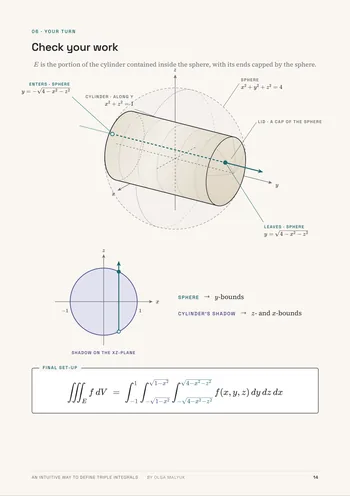
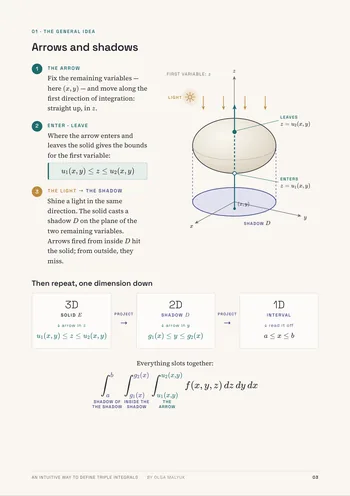
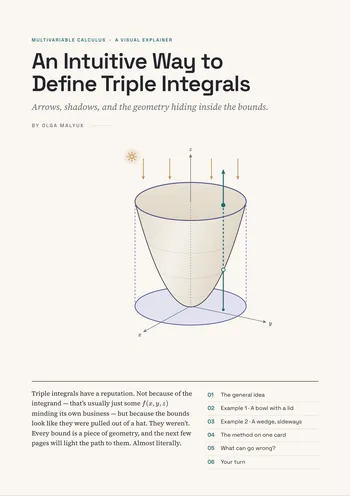
A visual guide to turning 3D solids into integration bounds.
Illustrated PDF, 16 pages, English
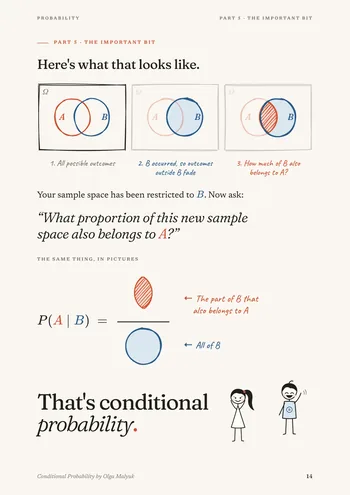
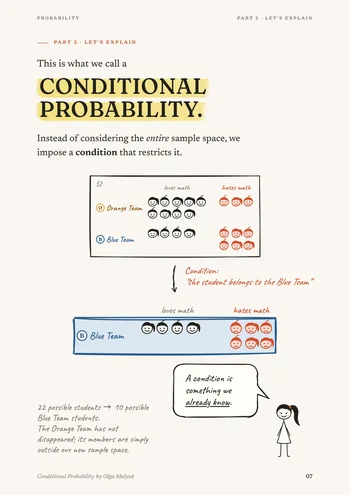
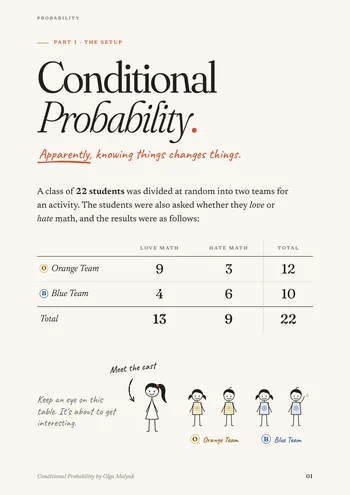
A visual guide to understanding how new information changes probability.
Browser game, English
A falling-hexagon arithmetic game: wherever three hexagons meet at a corner and one number is the sum of the other two, all three vanish.
In development, Site in Portuguese
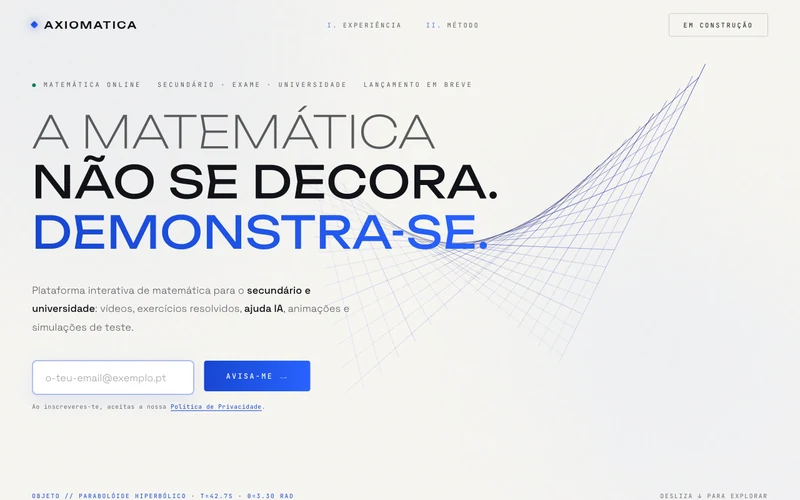
A mathematics learning platform for high school and college students, now being built around videos, worked exercises, animations and test simulations.
Small explorations in mathematics, learning and play. Animations, interactive sketches and ideas in progress.
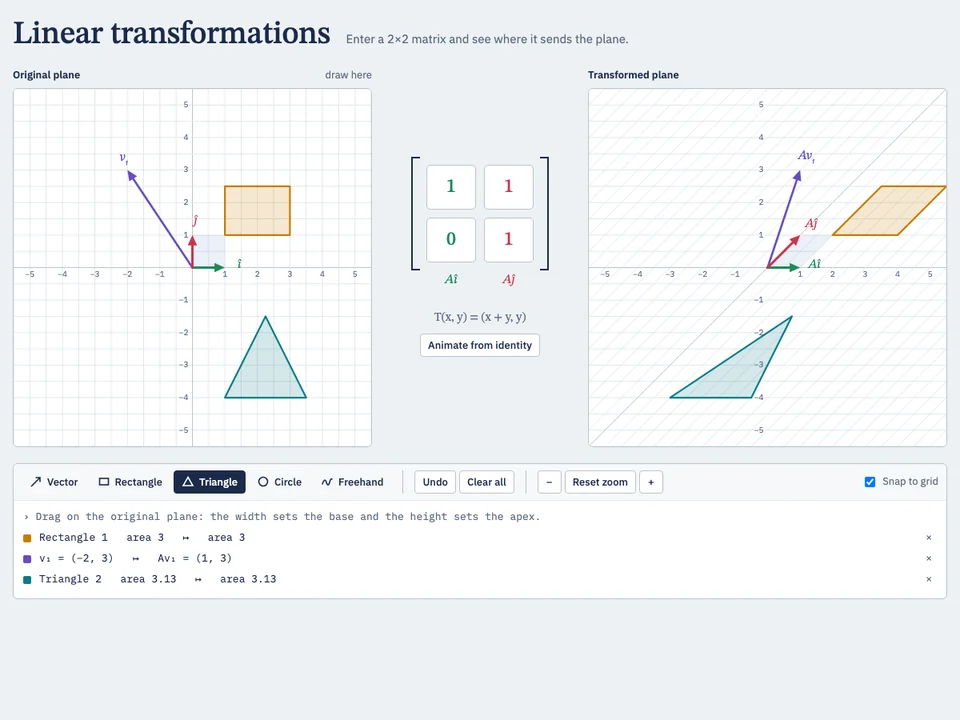
Enter a 2×2 matrix and see where it sends the plane.

I’ve loved math since I was a kid, but I don’t think I really understood what mathematics was until I went to college and took a course in pure math. Before that, school had always been easy for me. As the difficulty increased, though, I started to realize that the traditional ways of teaching weren’t really working for me.
It soon became confusing to hear long lectures, to see chalkboards covered with formulas, and to receive explanations which had no clear connection to anything I was able to visualize. I am one of the kinds of people for whom mathematics only really makes sense when they can see it, so I would describe myself as a visual thinker.
The resources I found online at that time helped me a lot, and they still influence the work I make today. Now I teach math through visual explanations, animations, and interactive tools that I create. A lot of my ideas come from the things my students get stuck on, as well as the struggles I remember having myself.
Interests: mathematics, education, design, technology, play